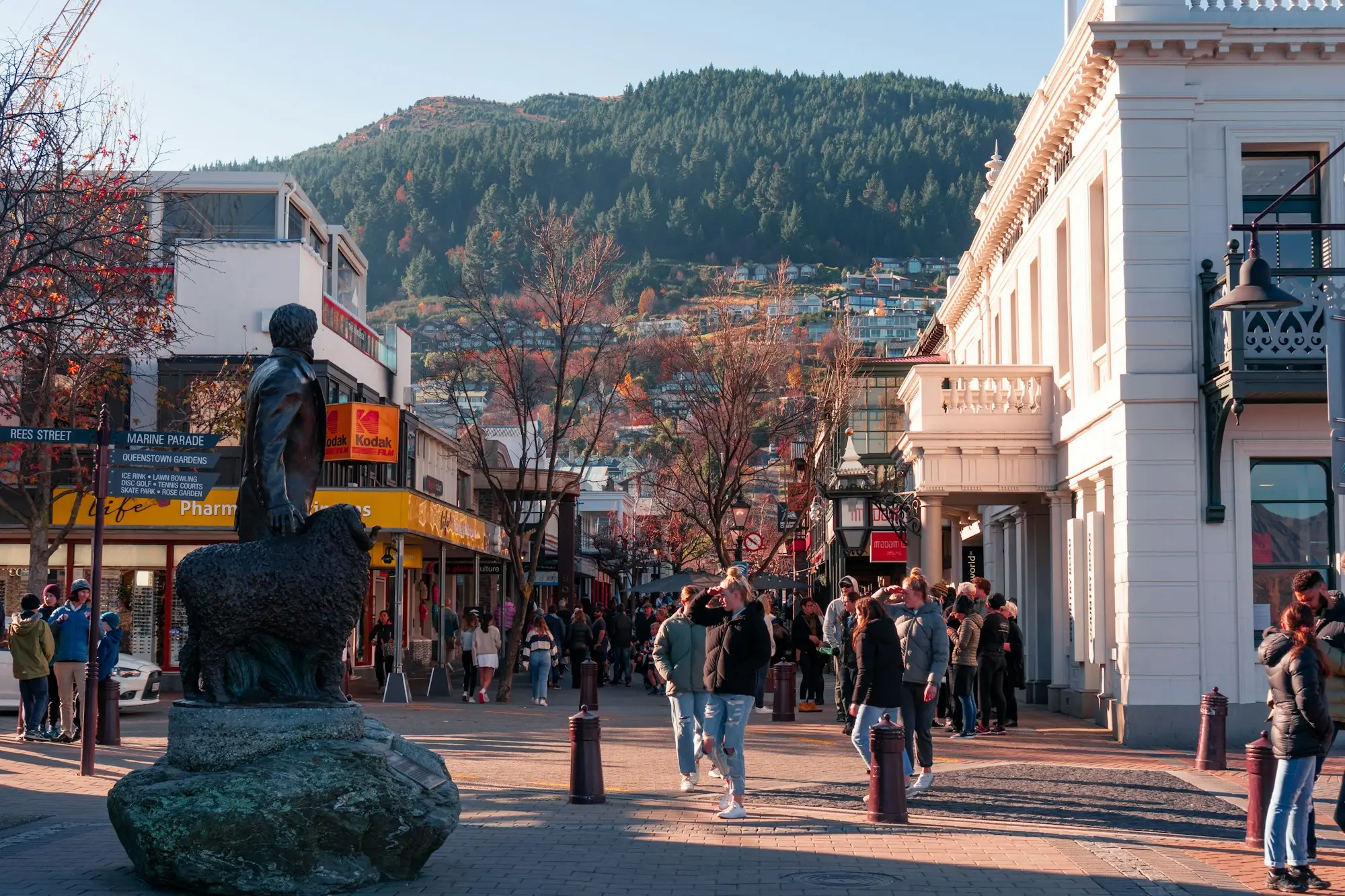
Quick answer
Queenstown main-street businesses usually fund pre-season stock and staff, fit-outs and quiet shoulder months with unsecured funding sized on turnover (typically $5,000 to $500,000) or property-secured loans from $20,000 to $5,000,000. The district averages around 29,463 visitors a day, rents are well above the national median, and labour turnover linked to housing pressure costs the local economy an estimated $105m to $200m a year.
Key points
- Queenstown Lakes averages about 29,463 daily visitors — roughly 35% of the local population.
- Median weekly rent in the district was $750 in early 2025, against $600 nationally.
- QLDC estimates higher labour turnover costs the local economy $105m–$200m a year.
- The Queenstown Town Centre Arterial road opened on 29 January 2025 after disruptive works.
Few New Zealand towns live by the calendar like Queenstown. Ski season fills the streets from mid-winter; summer brings hikers, cyclists and wedding parties; and in between come the shoulder months when owners finally take a breath. Add high rents, a tight labour market and a constant flow of visitors, and you get a main street where cash flow planning is a survival skill.
What’s shaping trade in Queenstown?
Visitors, every day. Queenstown Lakes District Council’s January 2025 housing briefing estimated the district averages around 29,463 visitors a day across the year — roughly 35% of the local population. That’s an enormous customer base for a town of its size, but it isn’t spread evenly across the year.
High costs of living and doing business. The same briefing put the median weekly rent in the district at $750, against $600 nationally, and described house prices as severely unaffordable. For business owners, that shows up in commercial rents and in what it takes to attract staff.
Staff turnover. QLDC estimated that higher labour turnover is costing the local economy $105m to $200m a year, as essential workers leave because of housing stress. Recruiting, training and housing staff is a real cost line for many Queenstown businesses.
Construction in the town centre. The Queenstown Town Centre Arterial road opened on 29 January 2025. Mayor Glyn Lewers acknowledged at the time that the works had been a challenging and disruptive period for local residents and businesses. Street upgrades have shaped how people move around the centre.
What do Queenstown owners usually fund?
- Pre-season stock and staff, ahead of winter and summer. See seasonal stock and funding summer staff.
- Tourism equipment and booking offices. See tourism operator loans. Adventure activity operators also need WorkSafe registration after a safety audit, which WorkSafe says typically takes at least eight weeks.
- Fit-outs in expensive, scarce commercial space, where every square metre has to earn its keep.
- Shoulder-season gaps, when fixed costs continue but visitors thin out.
- Recovering after disruption from roadworks, weather or access problems. See recovering after disruption.
How lenders look at Queenstown businesses
| What helps | Why |
|---|---|
| Twelve to twenty-four months of statements | Shows both peaks and both shoulders |
| Forward bookings | Evidence the next season is filling |
| A staffing plan | Shows you can actually service the season |
| Lease details | High rents and fit-out costs need enough term |
| Explanation of disruptions | Weather or access issues explained upfront |
Unsecured options — typically $5,000 to $500,000 for trading businesses — suit pre-season costs. Property-secured loans — $20,000 to $5,000,000 — suit bigger fit-outs, buying a business or projects that need a longer term. Many local owners have property equity they can use.
Planning for the next season? Start an enquiry and a person will help. No credit check to ask.
An illustrative example
Illustrative only. An outdoor clothing and hire shop does well in July and August, solidly in summer, and quietly in May and October–November. Each autumn it buys winter stock, hires seasonal staff and helps cover their first weeks of accommodation.
The owner arranges a facility in April sized from the cash gap estimator, repays it from August’s takings, and keeps the summer peak’s cash for the quiet November and the provisional tax instalment due on 7 May.
Local help worth knowing about
- Queenstown Lakes District Council — consents, licensing and town-centre updates.
- Destination Queenstown — the regional tourism organisation.
- Queenstown Chamber of Commerce — local networks and advocacy.
How do you plan for two peaks?
Queenstown businesses don’t get one busy season and one quiet one — they get two of each. That makes planning more complicated, but also more forgiving if you get the rhythm right:
| Period | Typical pattern | Planning focus |
|---|---|---|
| April–May | Shoulder — quiet | Winter stock, recruitment, maintenance |
| June–September | Ski season peak | Serve the peak, build the buffer |
| October–November | Shoulder — quiet | Summer preparation, refits |
| December–March | Summer peak | Serve the peak, put aside for the shoulders |
Each shoulder is short enough to bridge with planning and, where needed, short-term funding. The danger is treating a strong peak as spare cash — especially with a provisional tax instalment due on 7 May and another on 28 August.
What should a Queenstown owner have ready?
- Twelve to twenty-four months of statements showing both peaks
- Forward bookings or group reservations
- Lease details, including rent reviews
- Staffing and accommodation plans for the coming season
What about staff housing?
With rents well above the national median and a long waitlist for community housing, many Queenstown employers find that recruiting staff means helping them find somewhere to live. Some owners lease houses or flats for staff; others contribute to rent; a few buy accommodation.
If you’re considering it, treat staff housing as a business cost with its own budget: rent or repayments, furnishing, maintenance and the risk of vacancies in the shoulder seasons. Talk to your accountant about how it’s treated for tax, and to us about whether it should be funded separately from your trading facilities.
See what your Queenstown business could qualify for
From the lakefront to Frankton, Arrowtown and Wānaka, start your 60-second enquiry. Asking won’t affect your credit file, your details aren’t handed round town, and a person who understands two-season businesses will phone you. Please give accurate numbers for both peaks and both shoulders — it helps us match you properly first time.
Frequently asked questions
Do you lend to businesses in Wānaka, Arrowtown and Frankton too?
Yes. We help main-street businesses across the Queenstown Lakes district and Central Otago, including Frankton, Arrowtown, Wānaka and Cromwell.
Can I borrow in the shoulder season?
Yes. Lenders familiar with Queenstown expect quiet shoulder months. Twelve months of bank statements showing both peaks help them see the full picture.
Can funding help with staff accommodation?
Some owners fund staff housing to attract and keep workers. Whether it suits depends on your business and the property — talk to us about your situation.
Can I use a Queenstown property as security?
Yes, for business purposes. Property-secured business loans run from $20,000 to $5,000,000 using residential or commercial property through a first or second mortgage or caveat-style security.